Showing posts with label Data. Show all posts

Tuesday, December 29, 2015

Backupery - free backup of Evernote and Google Bookmarks for Education users

Image result for www.backupery


Backupery is a service that provides back up of your Evernote Data and Google Bookmarks.

It is free for education users. Backupery provides free licenses for teachers, students, or faculty members at a qualified academic institution, high school, university, or community college. The process to get the license is very simple - a user just needs to contact us and provide his/her name, and name of the institution or URL of the institution web page. http://www.backupery.com/edu/,

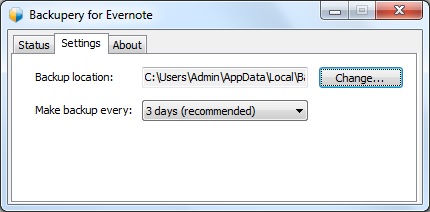
Backupery for Evernote is a Windows software application that performs regular backup of your Evernote data. This backup can be saved to your computer, external hard drive, USB memory, Google Drive and much more. It is easy to use and setup, easy to restore your date, backups attachments, works in the background, is secure and even has de-duplication and free space optimization.


Backupery for Chrome Bookmarks is a Windows software application that performs regular backup of your Google Chrome bookmarks. This backup can be saved to your computer, external hard drive, USB memory, Google Drive and much more. It is easy to use and setup, easy to restore your date, backups attachments, works in the background, is secure and even has de-duplication and free space optimization.


It is very important to have backups of your data. When I was CIO, I had my school district backing up all data to Barracuda Backup (on premise and 3 offsite) and had all of our Google Apps for Education data backed up with Backupify.

I backup my personal Google Drive files using the Google Drive sync app, and I do regular backups using Google Takeout of all of my Google Data. I also do regular exports of my Evernote data. All of my backups are also copied to an external hard drive, which I store in a fire-proof safe. I will now be using Backupery to also backup Evernote. I was using Revert.io but they were bought by another company (ThisData) and are no longer free (they do have excellent tools, including Google Admin, and pricing though).


Tuesday, April 21, 2015

Importance of having a Data Backup Solutions

CopyBackupFiles Want to backup files? Here are 8 free web applications that can help you

Data backup is even more important than ever these days. Everything is digital now and you need to safeguard and backup your data. 

I have my personal data backed up in multiple ways, and even backup my Evernote files with a free service. Our district has a Barracuda backup server as well as off site back up at Barracuda's data centers and we use Backupify to backup our Google Apps data.

Below are some more resources on data backup and an infographic from SingleHop with more information and resources on how virtual servers can help keep your data recoverable and secure.

Tuesday, March 24, 2015

Using Vernier Data Tools on a Chromebook


Determining grip strength with the Hand Dynamometer, Go!Link, and Graphical Analysis for Chrome

Chromebooks are very powerful, and very useful, devices. You can even use them with Vernier Data Tools.


Vernier is a huge name in data collection tools for science and math and they have been working to support Chromebooks for some time.  Earlier this year they released their Graphical Analysis tool for Chromebooks (free) and they have continued to make their products work with Chromebooks.


There are two different ways you can use their tools with Chromebooks. One is using a USB connector and the other is wireless. For the USB connection for the sensors, you need the USB connector and the Graphical Analysis Software. For the Wireless connection, you need the Labquest device and the software. Many schools already have the Labquest devices anyway.

USB
  1. Students begin their experiment by connecting sensors to their Chromebook USB port.
  2. Using Graphical Analysis for Chrome, students set experiment parameters and start data collection.
  3. Real-time sensor data is shown as a graph, a meter, or a table for different learning styles.
  4. Students can annotate their graph, perform curve fits, run calculations, and more.
  5. Students can easily create and send a finished lab report to their instructor, save their work to Google Drive™, or export data to Plotly™ for further study.
Wireless
  1. Students in a lab group set up an experiment with Vernier sensors and LabQuest 2.
  2. Each student launches Graphical Analysis for Chrome on a Chromebook and connect to LabQuest 2.
  3. After starting data collection, experiment data are wirelessly streamed from LabQuest 2 to each Chromebook.
  4. Every lab group member analyzes data on a Chromebook in class or at home.


Vernier devices and sensors are used by high school and college courses around the world and it's nice to see that Chromebooks are supported.


Related:

What can you do on a Chromebook? Pretty much everything.


Wednesday, January 22, 2014

An Interview with Tim O'Reilly on Open Data


Tim O'Reilly discusses open data with the McKinsey & Company Insight:
A platform for innovation It seems to me that almost every great advance is a platform advance. When we have common standards, so much more happens. And you think about the standardization of railroad gauges, the standardization of communications, protocols. Think about the standardization of roads, how fundamental those are to our society. And that’s actually kind of a bridge for my work on open government, because I’ve been thinking a lot about the notion of government as a platform. So much thinking in government is around, “Well, we’re going to build a program to solve this particular problem.” But the most successful government programs to me seem to be platform kinds of programs. And I’m not talking about, “Oh, well, the government funded the Internet originally.” I’m talking about things like GPS. The fact is that this is a military program that, through a crucial policy decision, was opened up for civilian use. If this was still just for fighter pilots, we wouldn’t have that Google self-driving car. We wouldn’t have maps on our smartphones. And that’s why I think this idea of a platform and the idea of a market go hand in hand so well. Because when you build a really powerful, effective platform, you do enable a market. 

Tuesday, December 3, 2013

MediaWeek (V7 N48): Amazon Drones, Digital Afterlife, PW Person of the Year + More

Lots and hype and hyperbole about Amazon.com this week.   At least Scott Pelley at 60mins went right to the top and managed to keep his hands clean.  As you probably know by now,  Amazon is going to deliver your toys to you with a toy helicopter.
Amazon is the world's largest online retailer, serving 225M customers worldwide. What's next for the company that prides itself on disrupting tradition? Charlie Rose interviews Amazon CEO and founder Jeff Bezos.


Other reporters tried out the drudgery of working in a warehouse to see how they were treated.  Guardian.
For a week, I was an Amazon elf: a temporary worker who got a job through a Swansea employment agency – though it turned out I wasn't the only journalist who happened upon this idea. Last Monday, BBC's Panorama aired a programme that featured secret filming from inside the same warehouse. I wonder for a moment if we have committed the ultimate media absurdity and the show's undercover reporter, Adam Littler, has secretly filmed me while I was secretly interviewing him. He didn't, but it's not a coincidence that the heat is on the world's most successful online business. Because Amazon is the future of shopping; being an Amazon "associate" in an Amazon "fulfilment centre" – take that for doublespeak, Mr Orwell – is the future of work; and Amazon's payment of minimal tax in any jurisdiction is the future of global business. A future in which multinational corporations wield more power than governments.
And The Economist on the same story.

Kevin Roose in NY Mag believes something more sinister(ish):
Instead, I think Bezos is up to something much more practical. By unveiling a huge drone program in progress, he's sending a message to the FAA regulators and Senate committees who are currently considering how unmanned aircraft can be used commercially. And that message is: Don't even think about getting in our way. By floating a teaser about the drone program, and allowing the public to freak out about it, he's showing regulators how popular such a scheme would be, and how much backlash they'd face if they outlawed it.

Also, NYMag will now go to bi-monthly printing rather than weekly.  There's an iPad version.

"New York has evolved dramatically since its founding in 1968, with its intelligence, humor, playfulness, and visual punch remaining constants," editor-in-chief Adam Moss said in a statement. "Readers will continue to find what they love in the magazine, and we're undertaking these new changes to meet their changing media habits on all platforms."  The company did not address any financial reasons for its print publishing cuts in the statement.  Nymag.com will have a new science blog, and more photography and political and cultural coverage, according to New York Media.

Questions about the digital afterlife from the FT:
The elderly who die today still leave behind an attic full of relics for children and grandchildren to rifle through: boxes of love letters and photos documenting the family history. But increasingly, such memorabilia is password-protected and stored online. Many wedding albums exist only on Flickr. The history of courtship and falling in love among today’s young newlyweds is documented on Facebook and in text messages.
“Look how awful people are when they fight over the couch or dad’s graduation ring,” says Josh Slocum, president of the Funeral Consumers Alliance, an advocacy group. “I can only imagine what the fight will look like over dad’s computer files.”
In the US, such questions fall into the messy intersection of state property laws, federal privacy laws and corporate policies of the companies housing online accounts.
A handful of US states have passed laws addressing the treatment of digital remains. In Oklahoma and Idaho, digital data are treated like tangible property. The executor of a will can take control of social networking or email accounts the same as bank accounts and houses, and decide to continue operating them or shut them down. In Indiana, a law allows access to those accounts but not control. In Rhode Island and Connecticut, only access to email accounts is covered.
The Atlantic notes the awarding to Oren Teicher as PW Person of the Year:
This year's selection for PW's Person of the Year represents a wholly different approach to the honor. It is Oren Teicher, CEO of the American Booksellers Association, and the ABA's board of directors, the organization that represents the country's independent book stores. The fact that these traditional brick-and-mortar, mainly locally owned bookstores are being recognized as outstanding contributors to publishing is not merely a sympathetic gesture to old-fashioned commerce in a generally downward trajectory. The accolade is justified by results defying the odds that so heavily favor the Amazon juggernaut and the chain stores, still led by (the struggling) Barnes & Noble.

From Twitter;
Yahoo’s Flickr Resurgence Continues With Handsome Photo Books, But Reliance On Sets Could Stumble
Prompt.ly Raises $1.5M Seed To Become The OpenTable For Time And Services  
Becksistentialism: because man is a goal-seeking animal  

Friday, November 15, 2013

Judge Chin Decides and Everybody Wins

About eight years ago I was one of the group at the Association of American Publishers that voted to file suit against Google for the unauthorized copying of upwards of 10million books (and other bound stuff) from the collection of five large academic libraries.  It wasn't long after the vote that I wished I had missed the meeting.

If nothing else, the passage of time since that suit was filed has proven that Google's activities were not the real enemy.  Google wanted to expose content locked away on shelves (off the network) to the same readers, researchers and other content users that the very same publishers were interested in selling to.  The risk publishers anticipated - that all content would be devalued and royalties due publishers would be circumvented - looks with hindsight to have been a red hearing.  The real problem for publishers with respect to the value of intellectual property quickly became apparent from the more obvious culprit: Amazon.com, which has successfully fought off the publishers, Apple, Google and everyone else and has won the battle over value.  After eight years, the (maybe) final end to the Google Books legal wrangle is a side show to the very real problems publishers have regarding their business models.

In ruling that the scanning program at Google was indeed fair use (and so emphatically that you have to wonder what took the guy so long) we may see some new products come out of this content library.  For example, I wrote of a subscription database product that Google could launch, others have spoken about the analysis of language, semiotics and culture that could be facilitated by this database and there will no doubt be other products.  What should be clear, is that access this ruling enables will enhance our knowledge and understanding about the content itself and the evolution of the printed word.  The next eight years might actually result in something useful.

There are four tests for fair use and Judge Chin as ruled as follows on these:

On purpose and character of use:
Google's use of the copyrighted works is highly transformative. Google Books digitizes books and transforms expressive text into a comprehensive word index that helps readers, scholars, researchers, and others find books. Google Books has become an important tool for libraries and librarians and cite-checkers as it helps to identify and find books. The use of book text to facilitate search through the display of snippets is transformative.
On the 'nature of the copyrighted work':
While works of fiction are entitled to greater copyright protection, Stewart v. Abend, 495 U.S. 207, 237 (1990), here the vast majority of the books in Google Books are non-fiction. Further, the books at issue are published and available to the public. These considerations favor a finding of fair use.

On the "amount and substantiality of the portion used":
Google limits the amount of text it displays in response to a search.
Lastly, on the "effect of the use upon the potential market for or value of the copyrighted work":
...a reasonable factfinder could only find that Google Books enhances the sales of books to the benefit of copyright holders. An important factor in the success of an individual title is whether it is discovered -- whether potential readers learn of its existence. (Harris Decl. ¶ 7 (Doc. No. 1039)). Google Books provides a way for authors' works to become noticed, much like traditional in-store book displays.
In his concluding comments the Judge states:
In my view, Google Books provides significant public benefits. It advances the progress of the arts and sciences, while maintaining respectful consideration for the rights of authors and other creative individuals, and without adversely impacting the rights of copyright holders. It has become an invaluable research tool that permits students, teachers, librarians, and others to more efficiently identify and locate books. It has given scholars the ability, for the first time, to conduct full-text searches of tens of millions of books. It preserves books, in particular out-of-print and old books that have been forgotten in the bowels of libraries, and it gives them new life. It facilitates access to books for print-disabled and remote or underserved populations. It generates new audiences and creates new sources of income for authors and publishers. Indeed, all society benefits.
The wider relevancy of this opinion on fair use may well extend the law and could result in implications for other media and content businesses.

Wednesday, September 18, 2013

CHORUS Update from AAP

From the AAP website, an update on the CHORUS initiative. The link to the proof of concept is to a 47 page pdf deck describing the status of the project.

Latest CHORUS Updates (posted 9/10/13)

Read the complete CHORUS Proof of Concept as presented to signatories, agencies and other stakeholders beginning August 30. This conceptual design report, presented by CHORUS Director of Development Howard Ratner, was the first milestone met in the rollout plan. Any questions, email info@publishers.org

Want to know How CHORUS Works? Check out this infographic.